 Gridlock Escape
Vehicles
Four heroes, four calls.
Every level has one hero, a vehicle with somewhere to be. All the others only get in its way. This page covers the four heroes and their missions, the ten civilian vehicles, and what any vehicle can and cannot do on the board.
What a vehicle can do
Hero or not, every vehicle follows the same rules. It slides along its own length only, forwards or backwards, as far as it likes through empty squares, and the slide is one move. It never turns, and it never passes through another vehicle or the curb. The hero’s one privilege is that the level ends when it reaches the gap in the right-hand curb. No other vehicle can leave the lot.
In every level of the game the hero is two squares long and stands in the third row from the top, facing the gap. Which hero a level has depends on its number alone: the four take turns, fire truck, ambulance, police car and taxi, so every fourth level belongs to the same one. Each of them leads 50 of the 200 levels.
The mission is the reward. It is not part of the puzzle and never changes the rules: once the hero is out, it drives down the exit street to its call and you watch it happen.
Fire truck
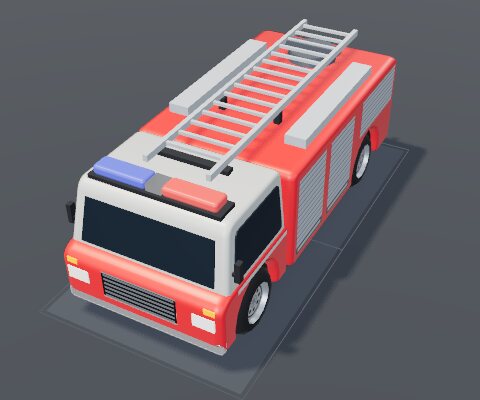
- Looks: a red engine with a white cab roof and light bar, roller-shutter lockers along the body and a silver ladder on top.
- Levels: 1, 5, 9 and every fourth level after that.
- Call: a long air-horn blast, then a wailing siren.
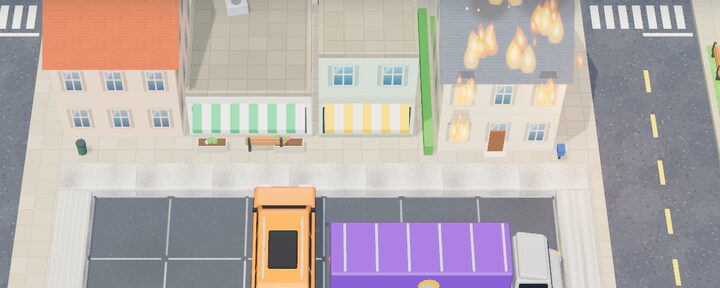
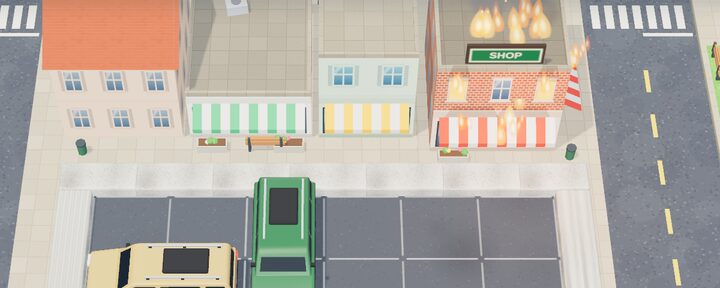
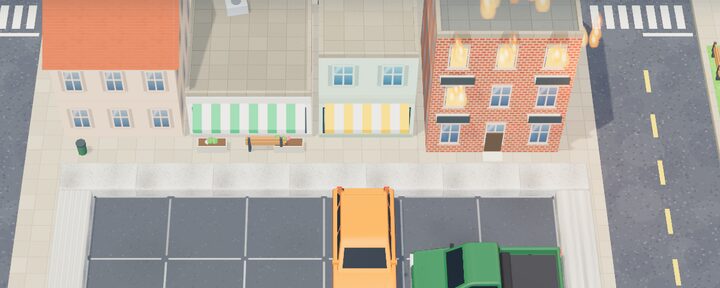
The fire truck’s call is not always the same. The fire levels take turns between four scenes, so it never finds the same thing twice in a row. At a crossing, two cars burn after a collision where a back lane meets the exit road. A two-storey house has flames in its windows and on its roof. A corner shop burns at its window and awning, with smoke rising off the flat roof. A block of flats burns on its top floor, and the truck stops further up the street for that one. Of the 50 fire levels, 25 are crashes, 9 are houses, 8 are shops and 8 are flats.
When the truck arrives, its two water jets put the fire out.
-
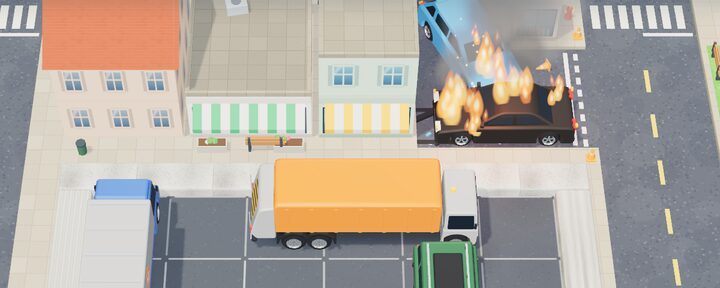
Level 1: the crash -
Level 5: the house -
Level 13: the shop -
Level 21: the flats
Ambulance
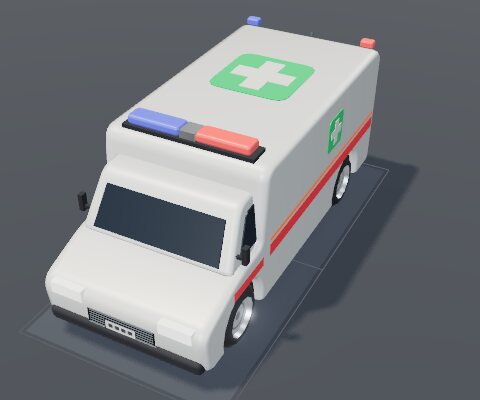
- Looks: a white box van with red and orange stripes, a light bar on the front edge of the box, corner flashers and a first-aid cross on the roof, white on a green square.
- Levels: 2, 6, 10 and every fourth level after that.
- Call: a held two-tone siren.
A patient is waiting for the hospital: a white clinic with crosses on its front, its street side and its roof, and a covered ambulance bay facing the exit street. When the ambulance arrives, the bay light turns green, the sliding doors open, and a medic rolls a stretcher out to the ambulance and waves.
-
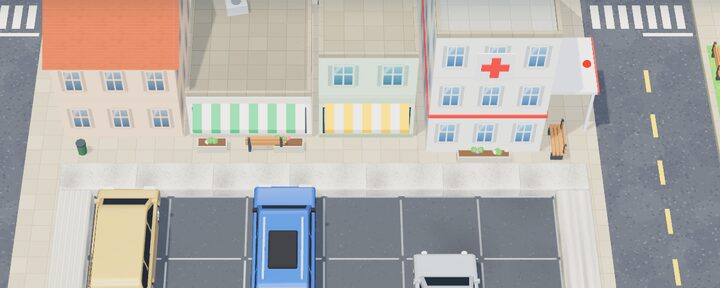
Level 2: the hospital
Police car
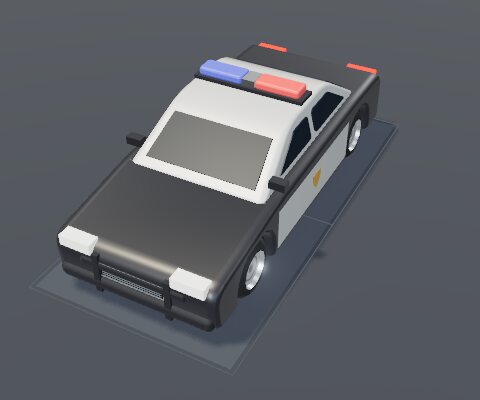
- Looks: a black-and-white sedan with a roof light bar, a push bar on the front and a shield on each door.
- Levels: 3, 7, 11 and every fourth level after that.
- Call: a police yelp.
A getaway is under way. The destination is a bank with columns, and in its forecourt stands the getaway car, hazard lights blinking, hemmed in by bollards so that its only way out is the exit street. When the police car arrives it stops across that gap. The getaway car lurches and gives up, the robber climbs out with his hands up, and a ring of stars spins over his head.
-
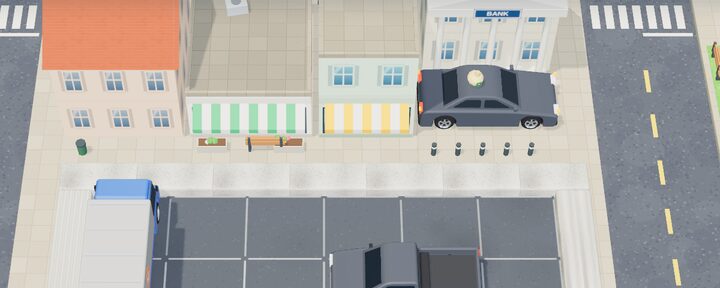
Level 3: the getaway
Taxi
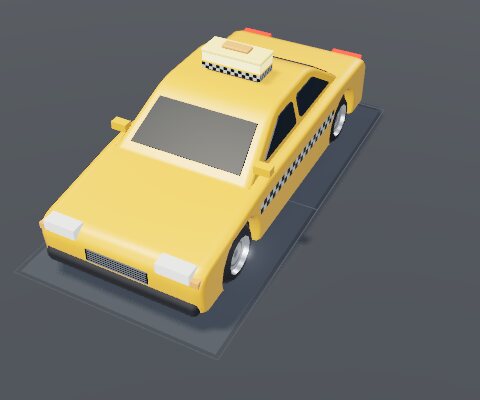
- Looks: a yellow sedan with a checker band along the doors, a glowing roof sign and hazard flashers at the corners.
- Levels: 4, 8, 12 and every fourth level after that.
- Call: two long honks.
A passenger is waiting. The destination is a hotel with a red entrance canopy and a HOTEL sign on the roof, and at the kerb a passenger with a suitcase waves for a cab. When the taxi arrives the passenger hops for joy, walks to the cab and gets in with the suitcase, and sparkles and confetti burst over the roof.
-
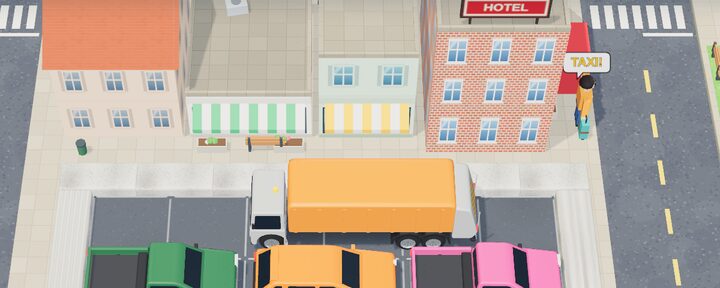
Level 4: the passenger
The whole fleet
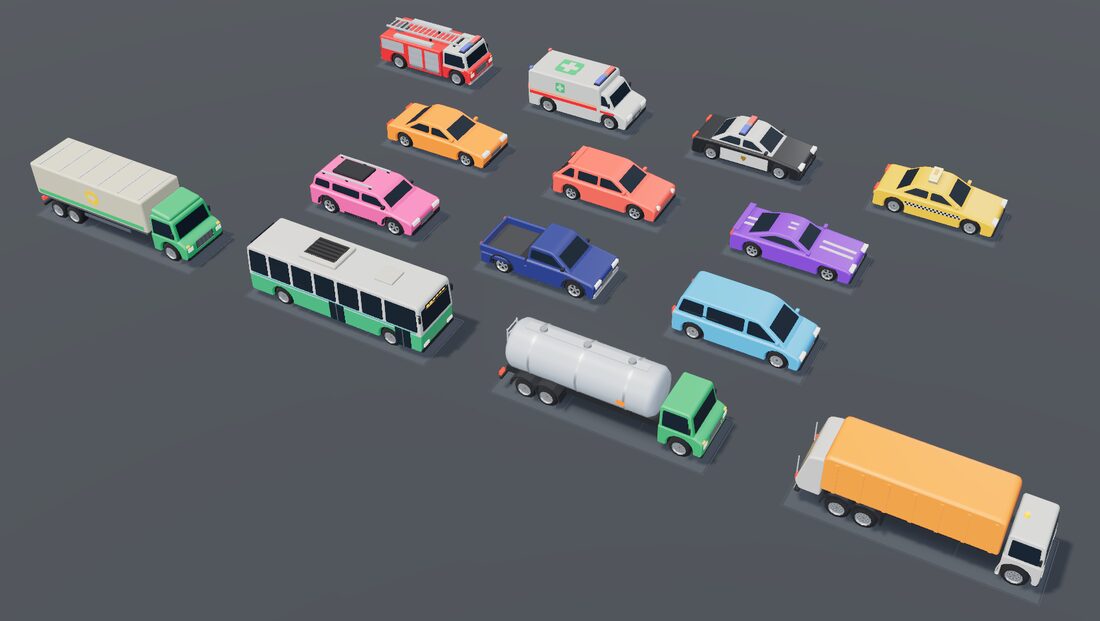
The game has fourteen vehicle models: the four heroes, six cars and four trucks. A vehicle’s length decides which group it belongs to. Two-square vehicles are cars and three-square vehicles are trucks or buses, so a three-square gap always means a truck of some kind. Which model, and which colour, a level’s civilian vehicles get is fixed by the level’s number, so a level looks the same every time you play it.
Cars: two squares
- Sedan. The everyday three-box car.
- Hatchback. Short and tall, with a steep tailgate and a roof spoiler.
- Coupe. Low and long-nosed, with a fastback roof, a rear wing and racing stripes.
- SUV. Tall and boxy, with high clearance and roof rails.
- Pickup. A cab up front and an open bed behind with a toolbox.
- Minivan. A rounded one-box people carrier with a long glass house.
Trucks and buses: three squares
- Box truck. A short-nosed cab and a tall cargo box with a livery stripe and a roller door.
- Bus. A long two-tone body with a full band of windows and a destination sign.
- Tanker. A cab pulling a rounded tank, with a walkway on top and a ladder at the back.
- Garbage truck. A flat-fronted cab and a tall ribbed refuse body with a raked rear hopper.
None of this touches the rules. A bus and a box truck both fill three squares and slide the same way. The paint is chosen so that you can tell the hero at a glance: civilian paint is bright toy colours that stay away from fire-engine red, taxi yellow, ambulance white and police black.