 Gridlock Escape
Designing Gridlock Escape
A hero with a call to answer, proven par, a town made entirely in code, what changed along the way and who built it.
A reason to leave
Gridlock Escape: Rescue Run is a sliding-vehicle puzzle. Cars and trucks sit in a six-by-six lot, each sliding along its own length, and the hero vehicle has to drive out through a gap in the right-hand curb. The design was written down on 4 November 2026, the day the first code was committed, and most of it survived the build.
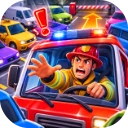
The first decision was that the hero should have somewhere to be. The fire truck has a fire, the ambulance a patient, the police car a getaway and the taxi a passenger. Clearing the path is the puzzle, and watching the hero reach its call is the reward, so a burning building, a clinic, a bank or a hotel waits at the end of the exit road. Later that day the fire truck’s call was made to vary between a car crash and burning buildings, and each hero was given its own voice: an air horn and a wail, a two-tone siren, a police yelp, two long honks. The vehicles page lists them all.
The rules we kept
The rules are the classic ones for this kind of puzzle, and we kept them because they are good. A vehicle is two or three squares long and slides only along its length. One slide of any distance is one move. Every level shows its par, the fewest moves it can be solved in, and gives one to three stars for how close you get.
The game has 200 levels in five tiers of 40: Learner, Commuter, Courier, Rescue and Legend. The level number follows the move count, so level 1 needs three moves and level 200 needs 49. The audience is 13 and over: the cars are for everyone, but the hardest puzzles are mostly for adults.
What changed on the way
Two things changed within two days. The first is the top of the ladder. The first version of the level pack, committed on the evening of 4 November, ran up to the hardest board we had found, 51 moves. Within the hour we decided that the two hardest boards in our database, at 50 and 51 moves, deserved a place of their own. They became the Summit challenge, each with an all-time leaderboard, and the levels now end at 49.
The second is that the design listed leaderboards, achievements, purchases and “online anything” as things the game would not do yet. Ranked daily, weekly and monthly challenges were finished on 4 November. Achievements, Game Center and Google Play Games, hint packs and saving progress with your account followed on 5 November. The challenges have their own page.
Made in code
Every model and texture in the game is generated in code: boxes, cylinders and extruded outlines for the fourteen vehicles, and canvas drawings for the paint, windows and road. The only picture the game ships is the app icon, which is the owner’s own artwork. The pictures on this site are captures from the game itself.
That keeps the download small, and it suits phones, where the budget is draw calls and triangles rather than polish. The civilian vehicles in the town are drawn in batches, one draw call per kind, and the scenery is merged. The camera can turn and tilt a little, but only on a short leash, because a camera that can get lost was written down as something to avoid.
The 3D scene and camera code came from an earlier Halfsky project, and the Android and iOS shells are the same thin wrappers around a web view that Halfsky’s other games use.
Who builds it
Gridlock Escape is built by Halfsky Publishing with Claude, an AI model made by Anthropic, working as a coding agent. The owner sets the requirements, makes the decisions above and approves what ships. Claude writes most of the code and the tests under that direction: of the first 95 commits in the repository, 93 list Claude as a co-author.
We do not take the code on trust. The solver proves every par, a script re-checks all 200 levels, and the project has more than 650 automated tests that run before anything is committed. How the levels are made describes the part of the work we are most careful about.
More from the news
-
How the levels are made
A solver that proves par, searches that fill a database of 244,425 puzzles, and the curve that picks 200 levels from it.
-
The web version
One game in two builds, static pages with no ads, a rewarded video only when you ask, and a consent step before any of it.
-
Where the apps stand
Android is in testing and sent for review, the iPhone app is set up and not yet submitted, and neither is in a store.